Islamic State Central Africa Province
How Bridgeway is using non-kinetic methods to disrupt a global terrorist group
Scroll to read
READ TIME: 18 MIN
Published
June 3, 2026
WRITTEN BY BRIDGEWAY FOUNDATION / PUBLISHED CASE STUDY

Undermining ISCAP from Within
While traditional counterterrorism efforts focus on prevention and deterrence, Bridgeway is using non-kinetic methods to reduce violent extremism. This strategy does not merely play defence by stopping more people from joining the armed group; it actively dismantles the group from within by encouraging defections and transforming fighters into allies for peace.
Our methodology arose from interviews we conducted with more than 100 former ISCAP members leading to a key revelation: many, if not most, fighters were unwilling participants in extremist violence. They wanted to leave the group, but defecting posed enormous risk. Instances of community retribution, or mob justice, against suspected ISCAP members posed another significant challenge to promoting defections. Acts of mob justice—both actual and rumored—were communicated back to ISCAP camps through the group’s collaborators in the communities. Meanwhile, ISCAP members who had been arrested and jailed in the DRC were able to communicate with the camps through ISCAP’s prison networks, reinforcing the notion that ISCAP members who tried to leave the group faced a bleak future: they would either be left to rot in prison or tortured and killed by an angry mob.
This basic truth prompted us to develop and implement an innovative and integrated strategy to dismantle ISCAP from within. Our strategy has four main pillars:
Diplomacy: laying the foundation for the success of non-kinetic solutions by establishing cross-border cooperation and protocols.
Community Sensitization: using media (radio, mobile cinema) and local leadership platforms to disrupt recruitment and prepare communities to receive defectors.
Defection Messaging: encouraging ISCAP fighters to abandon their weapons and reject violence.
Rehabilitation, Deradicalization, and Reintegration: providing former fighters and captives with a path away from extremism and toward peace.
Over 130 armed groups are based in eastern Congo alone. Islamic State Central Africa Province (ISCAP) is one of, if not the, deadliest of these groups. Since 2018, ISCAP—known locally as the ADF—has killed over 6,000 people, bringing devastation to communities, destabilizing societies, and launching or attempting cross-border attacks in Uganda and Rwanda that threaten regional security.

6M+
“Come home” fliers dispersed over ISCAP’s remote forest camps
500+
Former ISCAP fighters and group members rehabilitated and returned to their communities
ISCAP traces its roots to Uganda in the early 1990s, where Jamil Mukulu launched a failed insurgency, fled to eastern Zaire (now the Democratic Republic of the Congo), and merged his fighters with another insurgent group to form the Allied Democratic Forces (ADF).
As regional wars subsided and external support for the ADF dwindled, the ADF became isolated in its Congolese jungle camps. In 2013, intensified pressure from the Congolese military and UN peacekeepers led to a shift in the group’s strategy. The ADF began launching indiscriminate massacres against Congolese civilians. In October 2017, now under the leadership of Musa Baluku, the ADF pledged allegiance to the Islamic State, adopting ISCAP’s global jihadist ideology and engaging in even more violent tactics.
The integration of the ADF into ISCAP networks marked a significant shift in the group’s tactics, recruitment, and radicalization methods. Dwindling finances had limited the group’s operations, but the alliance with ISCAP (and, hence, access to ISCAP financing) led to new recruitment opportunities and to improvements in technology. From only 400 to 450 fighters in 2018, the group grew to 1,500 to 2,000 by early 2023—an increase of approximately 344 percent. Along with these fighters came more sophisticated improvised explosive devices (IEDs), new quadcopter drones, and better communications equipment and practices, all leading to escalating violence.
Recruitment patterns also evolved. Under Jamil Mukulu, the group relied primarily on Ugandan recruits who were often lured into the camps under false pretences or through family connections. While the group has continued to use deceptive and coercive recruitment methods, they now also recruit ideologically driven radicals from across East Africa, including Tanzanians, Kenyans, Burundians, and Somalis. These foreign recruits have taken on leadership roles, bolstered the group’s operational capabilities, and further radicalized other members.
More strikingly, ISCAP has intensified its reliance on violent abduction. According to open source data gathered by the authors, between 2013 and 2017, the group abducted approximately 255 civilians (4.5 per month). After joining ISCAP, this escalated to over 2,595 civilian abductions (30 per month) from 2017 to 2023. This shift in tactics, framed by the group’s leadership as a form of daw’ah (proselytizing), includes forcing abductees to convert to Islam or face execution. Those who convert undergo ideological indoctrination before being assigned roles within the group’s operations.
While many of ISCAP’s foot soldiers were forcibly or deceptively recruited, the group’s leaders and ideologues are deeply radicalized and continue to exploit a distorted interpretation of Islamic principles to justify their violent agenda and to employ deception and coercive tactics to recruit and control their members.
Research
Early on in Bridgeway’s mission against ISCAP, we discovered that there was almost no research based on testimony from those inside the group; most reports relied on community sources, which gave excellent insights into what was happening to ISCAP’s victims, but could tell us nothing about why it was happening, how the group operated, or what was motivating the attacks. To counter the group, we needed to understand what was happening inside it, not just the outward consequences of its operations. We stepped in to fill this gap, conducting research to help the international community and the academic community specializing in Congo and the wider Great Lakes region understand the true nature of ISCAP.
Adopting an epistemological and methodological approach that prioritizes primary sources—in other words, conducting our own research with former members and survivors of the group—Bridgeway has worked to understand ISCAP more closely and completely than anyone previously and to prioritize research that reveals the lived experience within ISCAP. Conducting hundreds of interviews with former members of the group, we have come to better understand the group’s history, internal dynamics, ideological underpinnings, international affiliations, and finances. And we have become a trusted source of information among the diplomatic, journalistic, analytical, and academic communities on ISCAP and conflict dynamics in eastern Congo.
Over time, we worked with internationally respected research institutions—Congo Research Group, George Washington University’s Program on Extremism, West Point’s Combating Terrorism Center, and the Hudson Institute—to publish long-form academic pieces that offered definitive primary research on contested topics, including ISCAP’s history, military operations, affiliation with the Islamic State, finances, and its ideological underpinnings. Bridgeway also published short-form analytical pieces with Stanford University and FDD’s Long War Journal. By highlighting the gap between our research methods, which relied on interviews with former ADF members, money transfer receipts, and other primary sources, compared to those of our critics, which were based largely on interviews with affected communities who had no insight into the ADF’s internal workings, we began, over the course of four years, to shift the narrative, work that culminated in the United States designating the ADF as ISCAP in March 2021 and the United Nations recognizing financial links between the group in June 2023 and acknowledging that the ADF’s allegiance with ISCAP began much earlier, in 2017.
Bridgeway’s research has corrected and aligned the global narrative around ISCAP—and most importantly, it has helped inform those directly impacted by ISCAP’s violence. Working alongside local authorities, community leaders, and organizations in the DRC and Uganda, we are arming frontline communities with the accurate information and strategic policy needed to disarm ISCAP.

FIG #2
Bridgeway’s cutting edge research on ISCAP dynamics and experiences within the camps revealed the necessity of helping disaffected fighters and hostages safely leave the group.
Diplomacy
In February 2021, Bridgeway began to raise the idea of a bilateral agreement between the governments of the DRC and Uganda and the creation of a task force suited to address the transnational threat of ISCAP.
Initially, many international diplomats were skeptical, dismissing the idea that Uganda and the DRC could overcome their difficult history and work together constructively against ISCAP. Recognizing, however, that the two countries had a shared interest in seeing ISCAP defeated, Bridgeway leveraged regional contacts from our 2010–2015 counter-LRA operations to begin sensitizing the idea on both sides of the border. Bridgeway’s work facilitated deeper relationships both vertically (between civil society and government) and horizontally (across the border) and communicated mutual interest in solving the ISCAP conflict.
These efforts, which were focused on a whole-of-government approach, complemented concurrent military outreaches between the two countries. Together, two major outcomes emerged from these processes: 1) In November 2021, Uganda and the DRC signed a Status of Forces Agreement, creating a counter-ISCAP military offensive, known as Operation Shujaa; and 2) In September 2022, the Ministers of Defense for the DRC and Uganda officially adopted the Bridgeway-brokered Standard Operating Procedures (SOPs), agreeing on how to process, treat, and repatriate members of armed groups who are detained by either the Congolese or Ugandan militaries in eastern Congo.

FIG #3
In November 2021, Bridgeway hosted a landmark bilateral conference between Ugandan and Congolese officials to establish humane treatment protocols for defectors. As a non-governmental actor with no political baggage, Bridgeway was uniquely positioned to broker this historic agreement.
In 2020, following our extensive research to understand ISCAP and its internal dynamics, it became clear that a major prong of Bridgeway’s future programming would be a defections campaign to reach ISCAP fighters and members who wanted to surrender. Yet we knew that the promise of surrender would only work if potential defectors trusted that they would be treated well upon surrender and allowed to return home. At that time, ISCAP returnees were almost invariably tried in military court and incarcerated in harsh Congolese prisons. Non-Congolese returnees were not allowed to repatriate to their own countries. This swift and firm punishment was the policy in Congo, a country that continues, with limited resources, to combat more than a hundred rebel groups.
In order for defections to work, Bridgeway had to change this policy. The first step was to distinguish ISCAP from all the other armed rebel groups—to show how ISCAP relied primarily on tricks and kidnappings to recruit members, meaning there were hundreds of victims and hostages inside the ISCAP camps, not just ideologically committed extremists. Then, Bridgeway had to present clear evidence of the benefits to the state and communities of allowing returnees to go back home. To accomplish this paradigm shift, in November 2021, Bridgeway Foundation, with the support of The Howard G. Buffett Foundation and the U.S. Department of State, organized a bilateral conference, bringing together ministers, military officials, diplomats, and civil society members from Uganda and Congo. Over two days, both sides engaged eagerly and productively on the topics, culminating in an official request to Bridgeway to present the governments with a proposed standard operating procedures for how to handle returnees. Working behind the scenes, Bridgeway helped negotiate and write this agreement, which was signed by the two countries’ Ministers of Defense in September 2022.
A major deterrent to armed group members’ willingness to defect or surrender is the treatment of returnees by security forces. The landmark SOP agreement lay the foundation for Bridgeway and partners to begin a defection messaging campaign aimed at drawing combatants out of ISCAP. Hundreds of ISCAP members have defected since April 2023, when Bridgeway began its defections campaign.
Bridgeway’s early, cutting-edge research revealed one key center of gravity that helps sustain ISCAP: its finances. Prior to its relationship with the Islamic State, ISCAP (then, still the ADF) was running low on cash, and the group was barely surviving. Now, most of the group’s money comes from outside of both Congo and Uganda, originating from Islamic State branches elsewhere in the world. It is only through the financing lifeline afforded by the Islamic State that ISCAP is operational and maintains such capacity for violence.
Bridgeway is dedicated to helping counter this illicit financial flow into ISCAP’s coffers, as we believe that if ISCAP is cut off from this externally sourced money, its capacity for violence in Congo and the region will be reduced drastically.
To cut off this crucial support, Bridgeway has worked with local authorities across East and Central Africa to trace Islamic State financial networks that help fund ISCAP’s violence. In 2021, Bridgeway documented one such financial network that transacted almost $400,000: it began with money generated by the Islamic State’s wing in Somalia; the money was then sent to financial nodes and cut-outs in South Africa; then to Nairobi, Kenya; and finally, to ISCAP operatives in the DRC and Uganda (among other recipients). In helping to identify this network, Bridgeway directly contributed to the dismantling of this revenue stream and indirectly contributed to the United States government imposing sanctions on four individual perpetrators.
While the Islamic State has continued to grow and adapt, opening other revenue streams to fund ISCAP, Bridgeway remains committed to identifying these networks and working with local authorities to disrupt the flow of money that funds ISCAP’s terror.
Potential ISCAP defectors need to know that they will not be tortured or indefinitely detained by security forces if they surrender. They also need to know that they will not face stigmatization or retributive violence in their communities once they return home. This requires educating the defectors, but it also requires changing the perspective of the communities on how to treat defectors. Several Bridgeway programs work in concert to shift the perspectives and attitudes of people in frontline communities toward defectors, showing that helping defectors safely leave the group is a viable path toward restoring security in the region.
Ukweli (Truth) Defection Committees
These community-led groups at the frontlines of ISCAP violence help coordinate safe defections and support the reintegration of returnees. The UDCs, composed of trusted local leaders from local government, security services, and civil society, play a vital role in encouraging defections by facilitating safe returns, preparing families and communities to welcome defectors home, and destigmatizing former fighters and hostages.
Bridgeway’s network of UDCs now includes 15 active committees—more than double the original plan due to overwhelming interest from communities—and is a testament to the power of building solutions from within affected communities.
Social and Economic Alternatives to Violence
Entrenched conflicts are harmful because of the lives lost due to violence—and also because of the lives disrupted by instability and chaos. While ISCAP is one of, if not the, deadliest armed group operating in Congo, responsible for claiming at least 6,000 lives, the group is also catalyzing a larger humanitarian crisis that includes displacement, food insecurity, and disrupted access to livelihoods, education, and healthcare. In a region still attempting to recover from decades of instability, where much of the population is reliant on agriculture for their basic livelihoods, ISCAP attacks have displaced thousands of farmers into urban centers, while making key transportation arteries unsafe for trade. ISCAP’s presence has impeded economic development; made people more vulnerable to hunger, poverty, and suffering; and made people more vulnerable to ISCAP recruiters who use the false promise of jobs, opportunity, and security to lure people into the group.
This is why the promotion of social and economic alternatives is a pillar of our community sensitization program. The community-based organizations (CBOs) we’ve funded offer economic empowerment opportunities in communities most vulnerable to ISCAP violence and recruitment. Bridgeway’s economic support grants to seven organizations in frontline communities served over 3,000 beneficiaries in agriculture, business, and education.
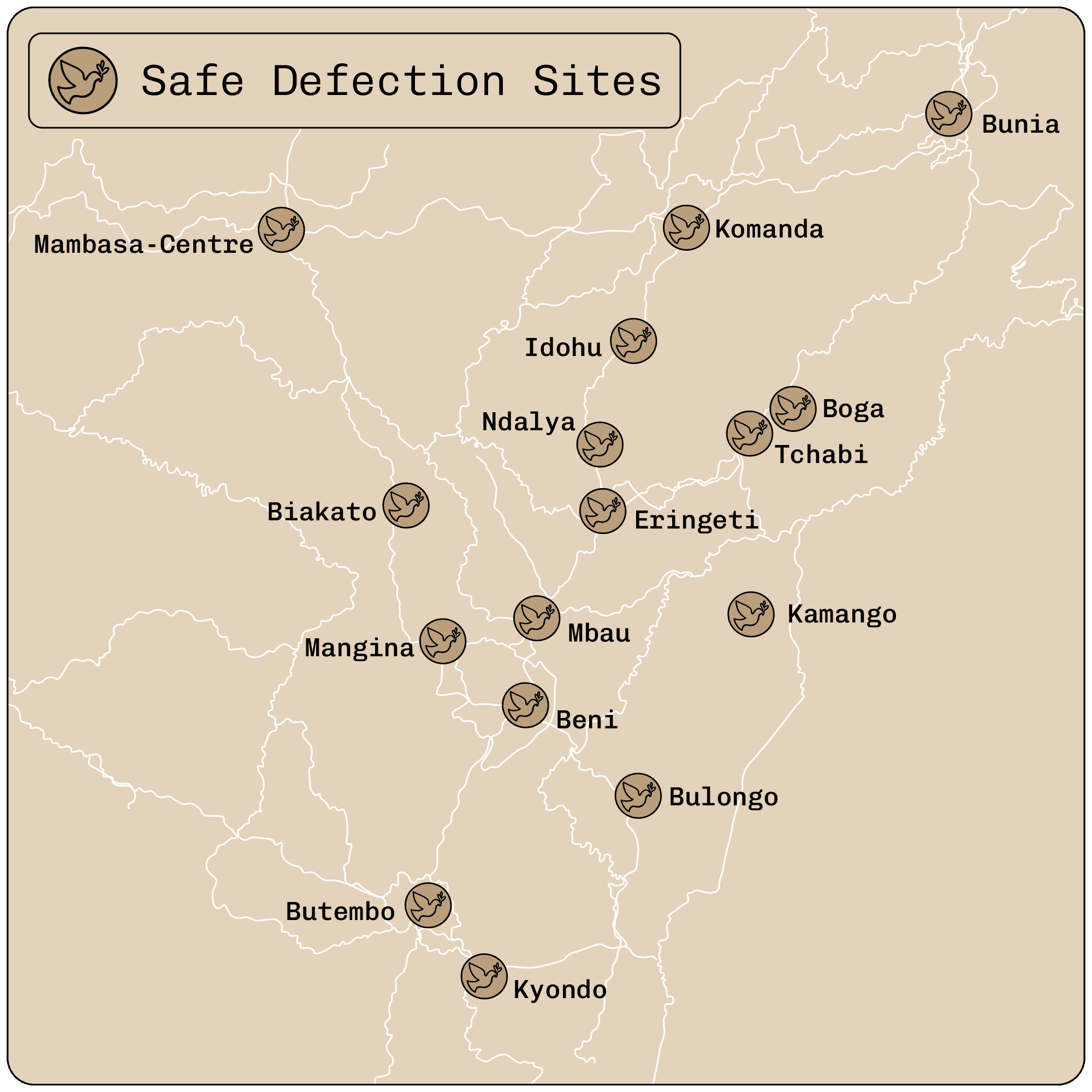
FIG #4
Bridgeway’s safe defection sites give ISCAP fighters and captives a viable way to leave the extremist group.
Radio Programming and Mobile Cinema
Wars are won on the battlefield—and they’re won in the hearts and minds of everyday people. Bridgeway’s radio and mobile cinema programs use accessible media and storytelling to educate frontline communities on the ISCAP conflict, inoculate communities against recruitment, and show that many of the people perpetrating the relentless campaign of violence and terror in eastern Congo are unwilling participants who were tricked or forced into joining the group.
Starting in August 2024, Bridgeway has produced and broadcast a weekly 30-minute radio program to counter misinformation, educate the population on how ISCAP operates, what the government and civil society are doing to combat the group, how to avoid ISCAP’s recruitment traps, and how to help promote the peaceful reintegration of returnees.
In August 2025, Bridgeway hosted the international premiere of Nūr, a feature-length fictional film created by Bridgeway to show the plight of people tricked into joining ISCAP. The film will be screened in frontline communities where the UDCs will facilitate dialogue on the complex struggles faced by victim-perpetrators and what communities can do to encourage defections and welcome returnees.
All lead actors in the film hail from Congolese communities on the frontline of ISCAP violence or are former ISCAP abductees who are now committed to helping others leave the group. Through compelling storytelling and meaningful collaboration, mobile cinema illuminates the inspiring dedication of people living within the conflict to shift community attitudes toward defectors and weaken ISCAP by helping captives and combatants come home.
Bridgeway also engages in community sensitization activities in Uganda. Though ISCAP is based in the jungles of eastern Congo, much of its rank-and-file, as well as senior leadership, are Ugandan. Yet there is a paucity of programming within Uganda dedicated to stopping this flow of recruits into ISCAP. In the near future, Bridgeway hopes to correct this and help stop individuals from being recruited into the group, which in turn will help limit the group’s manpower and thus its capability to conduct acts of violence. Utilizing a hybrid model that combines mobile cinema, the creation of additional local committees in eastern Uganda, and collaboration with these committees to create social and economic alternatives to the push and pull factors that leave vulnerable people susceptible to recruitment, Bridgeway hopes to see a significant reduction in those going into ISCAP’s ranks.
At the heart of Bridgeway’s work is a powerful insight: a significant portion of ISCAP’s ranks are there by force, not choice. Many were abducted, coerced, or misled, and want to leave. But fear, isolation, and propaganda keep them trapped.
Bridgeway’s defections campaign disrupts that cycle. Since launching in April 2024, the Foundation has operated weekly defections missions over ISCAP’s forest camps, delivering hopeful messages to those inside. Using aerial loudspeakers and the distribution of 400,000 “come home” fliers monthly, we reach deep into inaccessible territory and call on ISCAP fighters to defect, using the images and voices of former combatants who are safe, healthy, well-fed, and enjoying a life of freedom—much more impactful in drawing people away from extremism than ideological or fear-based content.
These messages work. In debriefs with recent defectors, many explicitly say that seeing or hearing Bridgeway’s content played a major role in their decision to leave the group. And roughly one-third of the returnees we work with in a rehabilitative setting volunteer to participate in the defection messaging, recording audio messages to be played over the camps or appearing on fliers enjoying life outside the camps, using their stories to encourage others to find their way home too.
As highlighted above, a significant portion of ISCAP fighters express a willingness to defect, and hundreds have already surrendered, many of them children and teenagers—both boys and girls—who were tricked, abducted, or coerced into joining. These individuals often return with severe PTSD and other mental health distress symptoms, some remain socially or ideologically connected to the group and lack a viable pathway back into society, and many are stigmatized by the community and struggle to fit in once they return.
Despite these barriers to building a viable life outside ISCAP, no government or non-governmental programs provided structured support for ISCAP defectors’ reintegration.
To fill this critical gap, in November 2021, Bridgeway established Al Shifa Home (ASH), East Africa’s first private rehabilitation center for former violent extremists. Through its holistic approach, ASH plays a vital role in fostering regional stability and attempts to serve as a model for addressing the complex challenges of violent extremism. ASH works by addressing three critical issues:
The underlying trauma of life in the bush and the psychological issues that may have driven returnees to join in the first place;
ISCAP’s radical ideology that fosters isolation and the desire to rejoin;
And the economic hardships that may have made returnees susceptible to extremism or false promises in the first place.
To achieve these objectives, and building upon the Bridgeway-facilitated 2022 bilateral agreement on defections, Bridgeway has formed strategic partnerships within the governments of the DRC and Uganda to help vet and enroll clients, provide graduates with a legal pathway home, and support ASH’s family engagement and reintegration initiatives. In creating and implementing ASH programming, Bridgeway has analyzed the successes and limitations of similar programs in places like Saudi Arabia and Nigeria and seeks to offer a comprehensive program that addresses socio-economic and political grievances as well as the ideological underpinnings of violence, and offers continuous monitoring and support post-reintegration.
A study of ASH’s first three years of operation shows promising results and reveals areas for continued development and refinement:
ASH has been transformative in enabling clients to process trauma, build coping strategies, and rebuild trust. Ninety percent of clients experienced a decrease in PTSD symptoms after three months of therapy.

FIG #5
Source: Created by Bridgeway Foundation using SRQ-20 results from the first three years of programming.
A cornerstone of ASH’s approach is the introduction of alternative, nonviolent interpretations of Islamic teachings to counter ISCAP’s exclusionary and distorted ideology. At intake, 81.5% of clients had a radicalization level ranging from average to very high. Upon completing the deradicalization curriculum, 88.9% of clients demonstrated low or very low radicalization.
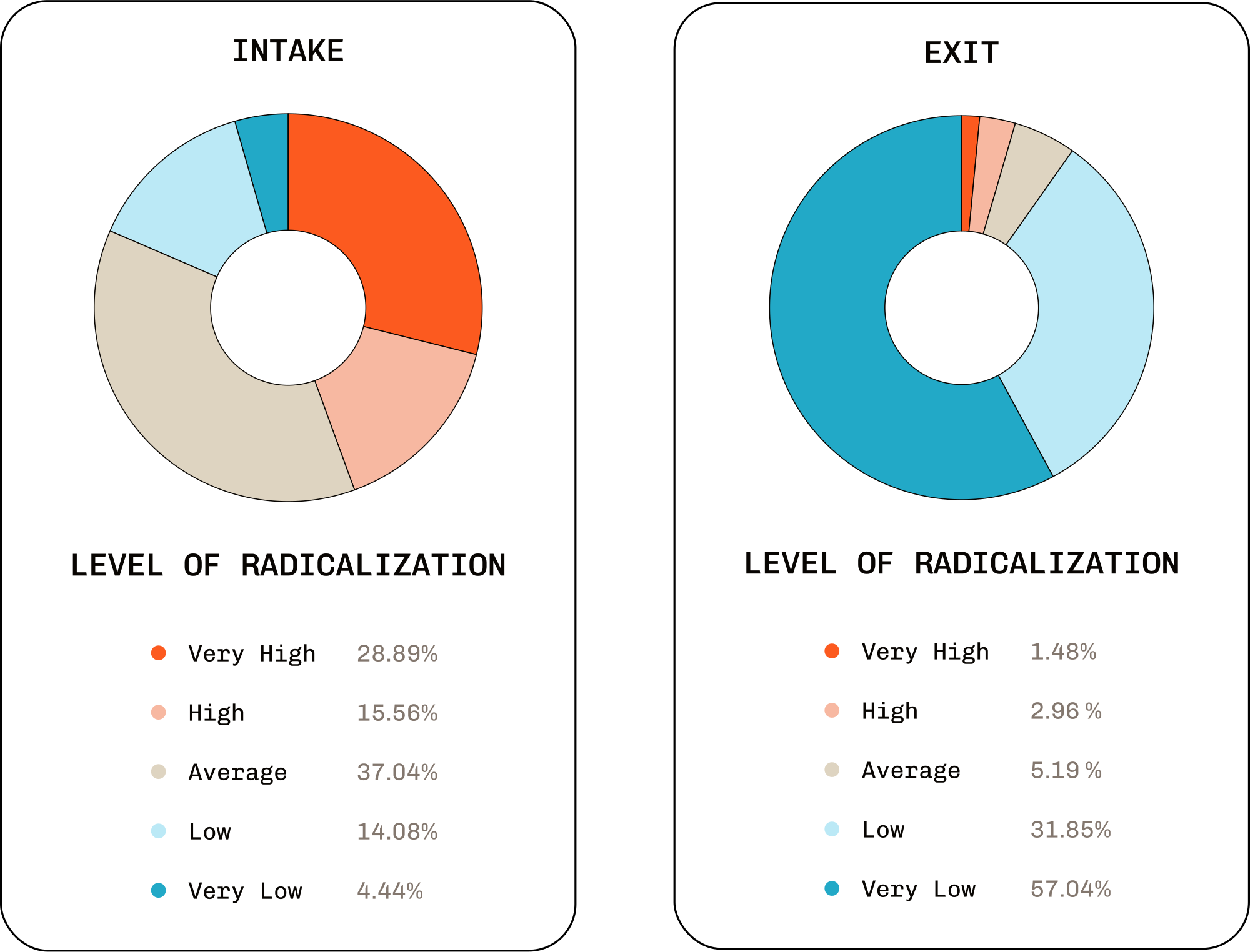
FIG #6
Source: Created by Bridgeway Foundation using program records
To lay the foundation for further education, reduce the risk of re-recruitment, and equip clients with the necessary literacy and numeracy skills for business and livelihood activities, ASH offers in-center training tailored to clients’ preferences, community needs, and local market demand, and post-reintegration mentorship and support, including a small livelihood grant to be used for further vocational training, start-up capital for a business, school enrollment, or ongoing medical and psychosocial care for clients who require long-term support that prevents them from engaging in livelihood activities.
Successfully reintegrated individuals provide the most powerful and persuasive defection messaging. Seeing a former comrade thrive outside the group directly challenges ISCAP’s propaganda and creates a compelling incentive for those still inside to defect. This type of messaging—rooted in real-life transformation—outperforms traditional counter-narratives by offering tangible proof that leaving is not only possible but beneficial. Reintegration, therefore, is not just a humanitarian goal but a critical component of further dismantling the group from within. ASH graduates are not merely recipients of aid but active agents of change in the fight against violent extremism.
ISCAP returnees become ambassadors for peace
On July 8, 2024, Mumbere Litofe (also known by the bush names Abadallah and Toyo)—a high-level ISCAP figure who spent 25 years in the group and rose through the ranks, ultimately becoming ISCAP leader Musa Baluku’s aide de camp—peacefully surrendered with four other combatants.
Toyo was only eight years old when he was abducted into the group while visiting family in Congo. He became the first ISCAP leader to leave the group after Bridgeway began its defection program. Since graduating from Al Shifa Home, Toyo has been an engaged and innovative participant in the defections campaign, helping generate defection fliers in several languages and creating a special video (accessible only by a QR code on the back side of each flier) that shows him reuniting with his mother and family and going about his daily life in recognizable neighborhoods in Kampala.
Bridgeway’s counter-financing, diplomacy, community sensitization, defection messaging, and rehabilitation, deradicalization, and reintegration programs work in an integrated way to weaken ISCAP’s capacity to commit mass atrocities. With each dollar intercepted, each fighter returned home, and each community equipped to disrupt recruitment and encourage defections, we actively degrade ISCAP’s capabilities while demonstrating a humane and effective alternative to violence. Together, these non-kinetic strategies have the power to disrupt extremist networks from within.
