The Lord’s Resistance Army
How Bridgeway helped dismantle the Lord’s Resistance Army through strategic counter-insurgency operations
Scroll to read
READ TIME: 16 MIN
Published
June 3, 2026
WRITTEN BY BRIDGEWAY FOUNDATION / PUBLISHED CASE STUDY

For decades, the LRA terrorized the citizens of Uganda and then committed sustained atrocities against civilians in three more central African countries: the Democratic Republic of the Congo, Central African Republic, and South Sudan. Since its inception in 1986, the LRA has killed more than 100,000 people, abducted approximately 30,000 children, and caused the internal displacement of at least two million people.
100,000+
People Killed
2,000,000+
People Internally Displaced
30,000
Children Abducted
90%
Violence Reduction
For many years, Bridgeway Foundation had been writing grants to help communities restore peace and repair from the effects of long-term LRA violence. Our grant partners in central Africa were of course doing incredibly important work—delivering humanitarian relief, looking after survivors, and trying to find local solutions to the LRA problem. Yet Kony continued to operate with impunity.

We began to reevaluate what was really possible. So far, we had been focused on funding: 1) research that documented the group’s crimes, hoping to shame Kony and LRA leadership into behavior change; and 2) policy recommendations, based on the field research, to counsel western leaders to use state resources to intervene in the conflict. But Kony and his leadership seemed impervious to attempts to stigmatize them for their atrocities—in fact, they seemed to relish their singularly brutal reputation.
And, because the LRA’s victims and targets lived in remote and undeveloped parts of central Africa, the group never constituted a threat to any western interests, making any real intervention difficult to justify. Local efforts to negotiate with the group routinely failed, and were merely used as a tactic by the LRA to rest and re-arm.
What was the western humanitarian community — what were we — really achieving?
The Lord’s Resistance Army (LRA), led by Joseph Kony, was formed in the mid-1980s, ostensibly to protect northern Uganda during years of political turmoil and violence. But by 1994, the civil war between north and south had all but fizzled out. Northerners, exhausted by decades of violence, were ready to embrace peace. The LRA had long since lost most of its local support, and Kony’s forces were dwindling. This is when Kony began abducting Acholi children—his own people—to fill the ranks of his flagging army. The LRA, which had been created to protect the north, began attacking its own, using looting, abduction, and violence to replenish its ranks and enforcing compliance through terror.
In October 2001, the U.S. government placed the LRA on its list of terrorist organizations. By 2005, approximately 1.67 million people were internally displaced across northern and eastern Uganda. In 2006, after over a decade of destruction and violence in Uganda, the Ugandan military, the Uganda People’s Defense Force (UPDF), succeeded in driving the LRA out of Uganda and into southern Sudan.
The Ugandan government entered into peace talks with Kony, and it seemed the group would soon be dismantled. Yet, still intent on overthrowing the Ugandan government, Kony had set up his new headquarters near Garamba National Park in northeastern Congo, where Ugandan troops weren’t allowed to pursue him, and in the two years that the peace talks dragged on and ultimately failed, his army rested, regrouped, and rearmed. By 2008, the LRA’s violence against civilians was reaching new extremes and had spread not only to Congo, but also to the remote corners of southeastern Central African Republic (CAR) and southern Sudan.
In 2010, in response to worsening LRA violence against civilians in central Africa, Bridgeway Foundation decided to try to stop LRA violence before it occurred and put an end to the group’s impunity.
While the International Criminal Court (ICC) had issued its first-ever indictments against Joseph Kony and other LRA leaders and had a mandate to prosecute them for war crimes and crimes against humanity, the ICC had no arresting power. Bridgeway wanted Kony and other perpetrators of atrocity to stand trial and face accountability for their crimes. We wanted to degrade the LRA, minimizing the group’s capacity for harm. And we wanted to protect civilians before violence occurred instead of responding to the aftermath of violence.
Many humanitarian organizations have developed strategies for helping communities rebuild and repair after disaster or violence. How could a private philanthropic organization responsibly help stop a violent armed group in very real terms? Bridgeway was in un-mapped territory and up against a group that was operating in a manner and environment that made it challenging to intervene.
For one thing, the LRA lived and operated in mobile splinter groups across three different countries in a remote area about the size of California. It was difficult to obtain accurate information about the LRA’s location and operations in such a vast and isolated region. No one knew where Kony and the splinter groups were hiding.
Though the LRA previously had used satellite phones to communicate, by the time of Bridgeway’s intervention, they had begun communicating mainly through runners or predetermined face-to-face meetings. The only evidence of the LRA’s plans or location was from the information that trickled in from communities after an LRA attack, or from abductees who managed to escape. Given the weak infrastructure in LRA-affected areas, these firsthand reports had to travel by word of mouth, often over huge distances connected only by narrow trails or unpaved roads. The reports of attacks came too late to save lives—if they came at all.
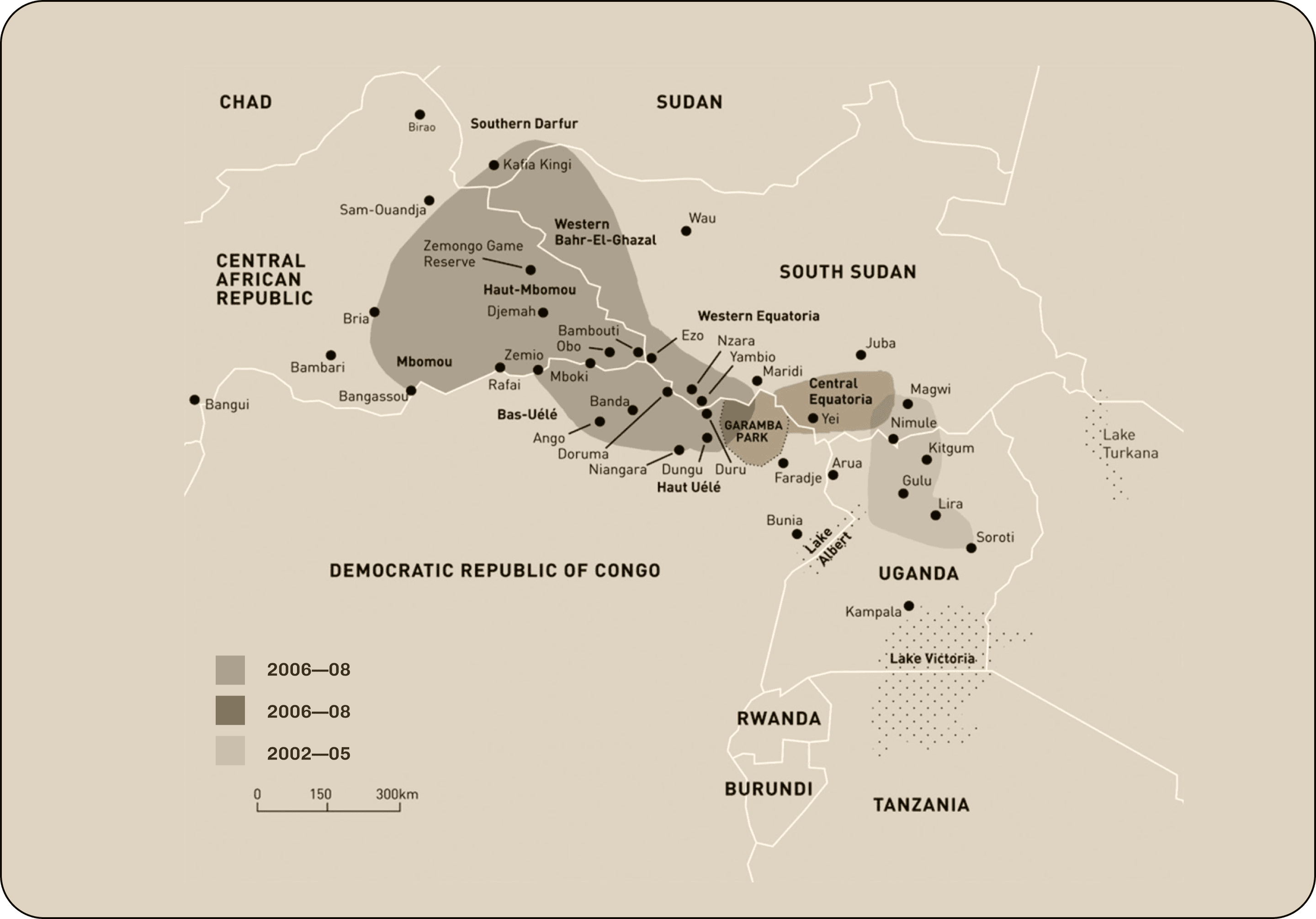
FIG #2
Map of the LRA’s area of operations. Source: Conciliation Resources
The African Union Regional Task Force (AU-RTF), the military arm of a multinational operation to counter the LRA, had a mandate to promote security and reduce atrocities in the area affected by LRA violence. But they needed specialized training to pursue the LRA’s small, agile groups in a dense forest and to match the LRA’s skill in difficult river crossings and counter-tracking methods. And since many of the LRA’s members were forced fighters and abductees, the AU-RTF needed to build their capacity in hostage release.
Bridgeway’s five-year intervention and partnership with the AU-RTF included three main pillars: tactical support; intelligence; and disarmament, demobilization, and reintegration (DDR) programs.
Military training
In consultation with human rights organizations, the U.S. State Department, and senior leadership within the UPDF, Bridgeway determined that a priority for improving the counter-LRA military effort was to train the AU-RTF soldiers to operate more effectively in the current environment.
Bridgeway hired Eeben Barlow, chairman of Special Tasks, Training, Equipment, and Protection (STTEP), to train a selective group of the AU soldiers participating in the counter-LRA mission. Barlow and STTEP stood apart from other private military companies because of their documented success in similar environments (for example, in counterinsurgency campaigns in Angola and Sierra Leone); because they viewed the endeavor as a philanthropic opportunity, asking Bridgeway to cover only their costs and salaries without charging commissions or exorbitant fees; and because Eeben, a South African, and his team were committed to cultivating African solutions to Africa’s problems.
Between March 2011 and February 2012, STTEP conducted two rounds of successful special operations group (SOG) training, selecting and training a total of 280 soldiers in specialized tactics, techniques, and procedures such as small unit operations and mobility, and operating in “pseudo groups”—small groups that were able to track and infiltrate the LRA through deception. Since so many LRA combatants were minors and forced conscripts, the SOGs also needed training in how to minimize casualties and rescue non-combatants.
The two trainings resulted in SOGs that were able to track and engage the enemy more effectively than other AU-RTF battalions. From the deployment of the first SOG in July 2011 until the SOGs rotated out in summer 2013, they were responsible for a majority of LRA member captures or rescues:

FIG #3
Number of attacks by the LRA in the AU-RTF’s area of operations. Source: LRA Crisis Tracker
Furthermore, following the first deployment of STTEP-trained forces in July 2011, there was a sharp decrease in the number of LRA attacks and civilian fatalities, and this marked decrease became a sustained downward trend. While other variables—for example, seasonal changes, adaptations to LRA strategy, and the deployment of U.S. forces—likely contributed to this overall drop in LRA violence, independent research corroborates that STTEP’s training created a mobile, adaptable, and effective fighting force.
Air support
When Bridgeway launched its counter-LRA campaign, the LRA was operating in an area roughly the size of California, most of the 90,000 square kilometers of terrain covered in dense jungle that made ground movement slow and difficult. Air support was absolutely necessary for troop transport.
Beginning in February 2012, Bridgeway contributed crucial and flexible air support, providing aircraft well-suited to the difficult operating environment, offering complementary capabilities and giving the UDPF an advantage in tracking and engaging the LRA.
Bridgeway provided a fixed-wing asset—a Cessna Caravan—capable of landing on short, unimproved (i.e., dirt) runways to transport food and supplies and a Bell 412 helicopter to transport troops, pick up defectors, provide medical evacuations from the field, and move supplies to forward operating bases.
Bridgeway’s air support filled a critical gap in the counter-LRA mission. The Caravan, the only airplane under the African Union Regional Task Force’s control, was responsible for resupplying the seven AU-RTF bases in Central African Republic. For the first four months after the Bell arrived, the AU-RTF used it for 75 percent of troop movements and 100 percent of medical evacuations from the field. Operations flown by the Bell 412 resulted in 56 percent of the captures and rescues in Bridgeway’s area of operations during the time the Bell was deployed, and these operations included major mission successes including the removal of top LRA commanders such as Okot Odhiambo, Binany, and Caesar Achellam. The Bell recovered 141 defectors and flew missions that killed or captured nearly 50 LRA members, significantly depleting the LRA’s ranks.
The Bell 412 also allowed the AU-RTF to react faster and pursue the LRA farther than it otherwise could have, giving the AU-RTF freedom of action based on time-sensitive actionable intelligence that required air support to respond. With the Bell 412 available, the AU-RTF could deploy almost immediately.
Finally, Bridgeway’s air support was important in winning the hearts and minds of the local population—key to any counterinsurgency mission. In an effort to build trust and goodwill with local communities, i.e., those most likely to encounter LRA forces in the region, the AU-RTF met with civil and religious leaders and provided goods and services, such as vaccines and transportation to and from Entebbe.
Tracking dogs
Following the completion of the SOG training and the deployment of the Bell 412, the AU began making more regular contact with the LRA—a major step forward that put the LRA on the defensive. Yet a majority of these engagements did not lead to results. To address this problem, Bridgeway brought in tracking dogs with the idea that the AU-RTF would embed the dogs with their security squads to pursue fleeing LRA members.
Tracking dogs led to contact with the LRA and produced tangible results, most notably in a mission that resulted in the death of LRA senior commander and ICC indictee Odhiambo.
On March 5, 2013, the SOGs were poised to launch an assault on LRA command and control headquarters in Kafia Kingi, a disputed territory between South Sudan and CAR. New evidence from a defector, corroborated by a GPS device and journal recovered in a successful counter-LRA operation, had confirmed reports that Kony was operating out of Kafia Kingi, and drone footage showed Kony with 40 – 60 combatants and roughly 125 women and children at the Kafia Kingi camp. This mission was deemed the best opportunity to date to apprehend Kony and dismantle the LRA.
The mission required four Mi-17 helicopters to transport the SOGs and bring back the women and children rescued in the raid. When it became apparent that the operation did not have the necessary air support, Bridgeway secured two helicopters and authorized the Bell 412 to enter Darfur.
In the meantime, the SOGs rehearsed the operation. The plan was to launch a night assault, but intelligence put Kony’s hut in the middle of the camp, which meant that the SOGs would have to navigate the surrounding fields and huts in the dark without raising an alarm. The AU-RTF built an exact replica of the camp and practiced infiltrating it, gaining confidence with each rehearsal that after almost 30 years of atrocities, Kony and the LRA would be stopped.
Unfortunately, this was not to be. Two days before the operation, with the SOGs already stationed at the forward operating base and Bridgeway’s helicopters on the ground, we learned that the camp was empty. While we’d understood the drone footage to be current, it was actually a few weeks old. New intelligence showed that the camp had been empty since at least February 25. To be safe, AU-RTF forces investigated and then destroyed the Kafia Kingi camp, but Kony and the entire group were long-gone.
While this failed operation was a devastating blow, especially to the SOGs that had trained so diligently, it was also an opportunity to change our strategy in two ways: 1) to build out our own intelligence apparatus; and 2) to focus less on capturing one man—Kony—and more on drawing combatants away from the group.
Human information
Prior to 2012, the AU-RTF relied almost exclusively on reconnaissance patrols to collect intelligence on LRA routes and campsites that informed AU operations. Such labor-intensive collection methods were not sustainable, especially as the AU-RTF expanded its area of operations into Darfur and central and northern CAR.
Starting in 2012, Bridgeway helped expand the AU-RTF’s human intelligence (HUMINT) network, giving satellite phones to local leaders, nomadic herders, hunting groups, and other key focal points throughout the LRA’s area of operations in central and northern CAR. The satellite phones helped ensure that sources could report in real time, allowing the AU-RTF to respond quickly.
Overall, these efforts provided the AU-RTF with timely and unique information, as well as the means to verify other intelligence reports. For example, in one operation that Bridgeway supported, the source photographed LRA members and their contacts. These time-stamped photos provided identification of previously unknown LRA personnel and proved that the LRA was meeting with Seleka rebels in CAR, something long-suspected but never before confirmed.
In another successful operation, Bridgeway worked with local community members in DRC to identify the camp of LRA Major Odano. The coordinates provided through Bridgeway’s support allowed AU forces to raid the camp, rescuing abductees and removing Odano from the battlefield.
Data Fusion
At that time, defectors had surrendered with a wealth of information from GPS handsets and personal experience that allowed Bridgeway and the AU-RTF to map current and historical LRA locations and behaviors. However, much of the data from nine years of counter-LRA operations in the region was kept in written situation reports that did not allow for easy access or quick comparison when planning for a new mission. Even after locating historical information, itself an arduous task, each data point had to be individually plotted by hand on a printed map—a labor and time-intensive effort that hindered rapid and thorough planning efforts.

FIG #4
A screenshot from the data fusion platform.
Once the database was populated, Bridgeway funded technical training for the AU-RTF to learn how to operate and update it, as well as to analyze the information and use spreadsheet software for data support. Bridgeway also brought satellite internet to the far flung AU-RTF bases so that the speed of communication and collaboration could increase.
Using current information combined with an analysis of past patterns of behavior, AU-RTF commanders were able to predict how the LRA would act and proactively deploy their forces. The data fusion platform allowed commanders to see trends in LRA behavior—for example, areas to which the LRA returned at regular times during the year or certain routes the group used during dry and wet seasons—and anticipate LRA activity in specific locations, which helped protect civilian populations from attack by anticipating LRA movements and also narrow areas for searching out LRA units hidden in the vast wilderness of Central Africa.
Defection messaging
Understanding that most LRA members had been forcibly recruited, often as child soldiers, and wanting to encourage combatants to come home peacefully, the Ugandan government passed a general amnesty law in 2000, promising an official pardon to former LRA members for any crimes they committed in the bush.
Kony and other LRA commanders sought to counteract the amnesty law with propaganda, convincing fighters that the Ugandan military would kill anyone who left the group and returned home, and offering incentives (promotions, women) to those who remained loyal.
Using air-dropped printed fliers and audio messages broadcast through helicopter-mounted speakers, Bridgeway aimed to combat the LRA’s false messages with information that: created homesickness; showed that a better life was waiting for LRA members who left the group; and created dissension within the LRA ranks.


FIG #5
Opio Sam was abducted into the LRA as a young child and he spent 24 years with the group before escaping in May 2014. These defection fliers, showing him safe and thriving, helped spur more defections.
The defection flier campaigns were usually small, targeted operations of 5,000 to 50,000 fliers that capitalized on significant events such as high-level defections. The fliers contained pictures of LRA defectors with UPDF commanders, showing that they were safe and unharmed; with their families, showing belonging; or in everyday situations, showing the good food and enjoyable activities available at home. The fliers also included a brief written message from the defector as well as maps with major landmarks to orient defectors and show defection points, and phone numbers of whom to call should an LRA member wish to defect. The fliers were printed in multiple languages based on the composition of the LRA group the messages were targeting, and then, using Bridgeway’s air assets, dropped over predetermined areas where intelligence showed that the LRA was actively operating. Fliers were also distributed among local hunting networks and other partners in the field who would leave them along paths the LRA was known to use. From May 2013 to February 2015 Bridgeway printed and distributed approximately 700,000 fliers.
Bridgeway was the first (and for five months, the only) organization to use helicopter loudspeaker messages to encourage defections from the LRA. The helicopter messages were short, targeted recordings that played on a loop as the helicopter flew over LRA-active areas. Bridgeway employees worked with defectors (and sometimes with the family members of LRA fighters) to record these messages and then, using a combination of SIGNIT, HUMINT, the LRA’s historical practices, and topographical clues, determined routes over which the messages would be broadcast. The messages could be heard from as far away as six kilometers; in an hour of flying, approximately 600 square kilometers could be covered.
Defection messaging was most successful when it was coordinated with military operations. By relentlessly pursuing the LRA, the AU-RTF created opportunities for LRA members to escape during the chaos of attacks or flight.
In 2012, 84 percent of adult Ugandan defectors reported having either seen or heard “come home” messaging. Many defectors credited the fliers or helicopter messages with influencing their decision to leave the LRA.
Reintegration
While defection messaging was vital in encouraging combatants to leave the LRA, the treatment LRA defectors received upon returning home also influenced fighters’ decisions to defect. Returnees sometimes remained in contact with LRA members still in the bush. If defectors were happy and able to restart their lives, other fighters might also choose to leave; but if returnees were mistreated or struggling to survive, others would be less likely to take the risk of leaving the LRA.
Despite the importance of returnees’ successful reintegration to the counter-LRA campaign, few organizations existed to ensure that defectors were well taken care of, and many defectors reported that they received little support upon returning home.
Bridgeway stepped in to support a number of local organizations to help LRA defectors reestablish their lives after leaving the bush. Bridgeway provided “defector kits” (with clothes, toiletries, kitchenware, and bedding) to returnees and supported local organizations in CAR and northern Uganda that helped returnees gain official amnesty, reunite with their families, receive vocational training, and participate in “cleansing” ceremonies that helped communities accept defectors.
Bridgeway was the only organization helping defectors when they first returned from the bush. While various organizations provided counseling and vocational training to already established returnees, no other organization facilitated the transition from the bush to home. By facilitating amnesty for 84 returnees, Bridgeway removed a deterrent to defection.

In this award-winning short film, former child soldier David Ocitti comes to embrace the rebels who ripped apart his family, helping them find a second chance in life.

Bridgeway successfully pioneered a new approach to conflict resolution, bringing the flexibility and commitment of a private organization to complement the dedication and will of the AU-RTF.
Bridgeway’s success in the counter-LRA mission can be attributed in large part to our close relationship with the AU-RTF, cemented by the decision to be co-located and by our uniquely collaborative approach. In choosing to be co-located with the AU-RTF, we built trust and credibility and increased the effectiveness of the partnership. The AU-RTF recognized the sacrifices our staff made in living on their bases–for example, sleeping in tents and cooking over a camp stove for years—which demonstrated Bridgeway’s commitment to the work and engendered trust. Co-location also gave us unique insight into the AU-RTF’s abilities and challenges so that we could provide resources best suited for the operators and the environment. The proximity also meant that the AU-RTF had constant access to Bridgeway’s assets, and we could monitor their use and adjust policies as necessary.
We were also willing to work with the AU-RTF to identify needs rather than arriving with a predetermined blueprint for our mission; this collaborative approach fostered goodwill among AU-RTF commanders and made them more candid about the AU-RTF’s shortcomings, helping us identify solutions that were best suited to the mission.
Bridgeway’s flexibility was another advantage to the mission. We were responsive to the AU-RTF’s needs, making our assets readily available, responding quickly to new opportunities, and ensuring that the specific resources we provided were the most appropriate for the mission.
Bridgeway also brought a unique continuity of presence to the mission. While other organizations either did not have a constant ground presence or else rotated staff every few months, the same Bridgeway staff remained on the ground for the entirety of our five-year intervention, building relationships and credibility.
Overall, Bridgeway contributed to the AU-RTF’s tactical and intelligence operations, helping the AU-RTF become a better-targeted and more effective force. Bridgeway funded and oversaw the training of two special operations groups (SOGs) that were responsible for 68 percent of captures and rescues in their area of operations.
Most of these successes in the battlefield came after Bridgeway began supplying a Bell 412 helicopter to the counter-LRA mission. The addition of a flexible tactical air asset, combined with troops specifically trained for small-group jungle warfare and hostage release, greatly increased the AU-RTF’s ability to respond. For nearly two years, the AU-RTF relied on the Bell 412, using it in 56 percent of captures and rescues in Bridgeway’s area of operations.
Bridgeway simultaneously helped the AU-RTF expand its HUMINT network, improving the AU-RTF’s ability to pursue the LRA in an expanded area of operations, and provided a data platform that made historical and present data accessible and actionable.
In addition to tactical support in the form of military training, air assets, and improved intelligence, Bridgeway used non-kinetic strategies to draw LRA members peacefully out of the conflict. Working with the USG and other organizations, Bridgeway’s defection messaging program helped 730 former combatants and hostages safely leave the group. Bridgeway’s reintegration program, the only one supporting LRA returnees in the precarious transition from the bush back to civilian life, contributed to the long-term success of defectors, which in turn encouraged more disaffected fighters to leave the group.
Bridgeway’s dedication, flexibility, innovation, and on-the-ground presence shaped a new model of humanitarian intervention, showing that a private organization can indeed make a measurable and significant impact on conflict mitigation.